I have not posted anything in a very long time, due to the fact that my main mode of communicating online switched from PC to tablet two years ago, and having to write using the screen keyboard is like trying to type with marshmallows on your fingertips. Now that I have finally solved that isssue recently by picking up a wireless keyboard, I am going to be writing again on this blog. So you, the one guy that reads this blog, be prepared.
-E Castleman
We have all witnessed it: The young talentless and clueless person on stage in one of those singing shows. It almost seems a bit fake at first, but as they begin to cry it becomes convincing, and we start to hear them speak in disbelief, as if they are the part of some sort of practical joke, and in all reality they aren’t bad as the reactions from the judges would suggest, but are actually good at what they are attempting. We see this all of the time in our daily lives, and it is no more apparent in our culture; this notion that a person thinks “I was born to do this”, when from the outside, it is quite apparent it isn’t what they should be doing. It is a pride thing, as well as a false image thing.
Does anyone ever read the bible with a Calvinist perspective and think that just as easily as someone can read it to be certain of salvation, another can read it and be certain salvation will never be theirs? Let us be honest; this is what the system entails. For every elect there is one, if not more who are not in the redemptive plan of Christ. So, by my estimation, this means that more so than not, those who are reading the bible are on the outskirts of God’s favor. Notice though, nobody ever reads it as if they are not in fact Jacob. Everyone reads it like they are the pretty princess at the ball, and if I were to guess, which can be a dangerous thing, I would guess that a Calvinist would hear this and think that the non elect probably do fool themselves into believing that they are counted among the elect, when in fact they are wolves in sheep clothing.
However, one must wonder as to how a person can determine if they are one or the other. With so much a stake, and a system that prides itself on the finished work of Christ being a covering, and done and paid for 2000 years ago which is yours at the switch of sola fide , then I must assert that this very problem is scary enough to turn this therapeutic soteriology on its head.
What one is left with is the reality that we can only rest on personal experiences, however,the problem is that personal experiences are impossible to compare. Though similarities in euphoria can seem comparable, one would imagine that those kids on stage that are so blind to their lack of talent experience some type of euphoria in believing they are in fact “called by God to sing”.
Even more; I wonder how it is with such doctrines as total depravity that we can even trust ourselves with such a decision. We are fallible, aren’t we? This was one of the tenets in rejecting tradition if I remember correctly.
I guess what I am trying to get at is that the sales pitch of sola fide rests upon Christ’s finished work, however, it might not just be for you, and that takes the wind out of such a statement going from relaxing to nightmarish.
IT IS GOOD TO BE BACK!
Is Eastern Orthodoxy Greek Platonism?
When a person is convinced at a certain point of reformed theology, and then goes onto disagreeing with reformed theology for Roman Catholicism or Eastern Orthodoxy, what would happen of they then reverted back to reformed theology? Can Sola Scriptura really be believed, when they themselves are a walking contradiction in that they have proven through practice, that they shouldn’t rely on themselves for biblical interpretation?
I always think about this when a Protestant tries to argue with me. What would I be left with, if I were to go back to reformed theology? Only another step in my view that scripture cannot be handled by me.
The consistent step for me, if I were to ever be convinced Orthodoxy is false, would have to be a step away from Christianity, any other step would be a contradiction. The reason for this, is because reformed theology isn’t a cosmic theology, but reaction religion, that only exists if Rome is the whore. Reformed theology couldn’t have existed prior to Rome’s perversion of the gospel, and as St Maximus says, you then must be grateful for evil, because you wouldn’t know the good without it.
This goes hand and hand with my process of deciding between Roman Catholicism and Eastern Orthodoxy. Reformed Christians mocked me for changing over to Eastern Orthodox from Rome (convinced of) as if it proved their views true, as if me showing that I can be wrong about what is true is in any way more proof of sola scriptura, when in fact it is more proof against it.


I have been having an exchange with Drake Shelton over at Green Baggins blog recently, and though I have found it somewhat pointless, I can’t help but wonder how many times I have to hear the same type of thoughts coming from the reformed before I lose my marbles. It is as if they cannot see that their way of thinking is really arrogant, and, if I may say so myself, leaves little room for fallibility. In Rome there is only one pope who claims to be infallible, but in Protestantism, everyone is a pope. It seems as though a reformation defender will always try to convince me that I need to weigh the facts about Orthodoxy before I commit, as if they have, and I just am a liar, or out of mind. However, they reveal something about themselves when doing this.
Take for instance James White’s post, where he gives people who are considering converting to Rome some things that they should think about before converting here
Then recently, Drake Shelton writes something similar with me in mind:
“I hope you return to the Reformed Faith. As a convert to the anchoretic movement, did you consider all that this entails before you left? Did you consider that your churches were already given centuries of playtime and they left their countries in a master-serf state of economic and politic scandal that gave rise to the Russian communist rejection of Christianity in the 20 th century? Did you consider that God destroyed your great cities with Muslim invasions due to your idolatry? Have you traced the influence of the welfare state known as monasticism through the centuries of Christianity? The best that can be said of the monastic system, which is at the heart of your religion, is that after its Church failed to reform Rome and establish a Christian Civilization, God judged it for its decadence and the monasteries housed the little literature that would later be used to keep the master class literate enough to keep some semblance of civilization afloat through the dark ages (Rome was still connected to you at this point). That’s not too great of a resume man. The Protestant Reformation is the golden age of human history. I have yet to find a convert to the Anchoretic Churches who understands this. You need to come to grips with something. You are going to have to go back to some kind of master-serf- divine right of kings system of civilization, which was popular in Orthodox Christian Russia, and completely deny the human rights that came out of the Protestant Glorious Revolution and the English Bill of Rights. Your monasticism is going to commit you to a hard core socialist view of economics- you may even start to dabble in Sir Thomas Moore’s (Later Jesuit system) Communist trash but either way its bleak man. Are you seriously prepared to do this?”
I wonder, do these people, when receiving new followers into their system of thought, run down a similar list to make sure these people understand why they left their last church, or former system of thought? Nope. I know, that if I were to tell them I agree with them, and am converting back, they would just say that I have made the right choice. I know that my old church would teach some classes for a month or two, then set up a date to receive the new converts, without ever questioning if they understood the good and bad things about reformed theology, or, even understood the good arguments place against reformed theology. What they are saying when they do this, is that they don’t need to know what other people think, because they are correct. They are popes, who have been taught by the Holy Spirit. They are not fallible. I have actually heard of a respected reformed teacher saying before a debate against some well known Roman Catholics, that he didn’t need to read any literature on Roman Catholicism, because reformed theology is correct. This is the same thing these two above me are saying.
However, let me set something straight. When I first started agreeing with Orthodoxy, I met someone who is now a very close friend, and a well respected Orthodox thinker, and told him that I was going to pursue Orthodoxy. He told me right off the bat, that I needed to read more, and sit for 3 years before making a commitment. He told me that the fact that I left reformed theology after agreeing with it, requires that I examine myself if I actually believed that it was wrong – after all – I was also confessing that I was wrong all of those years as well, so it makes sense that I reflect on why I made such a mistake. Later I met with who is now my priest, and told him about my past, and he told me that we had to wait a year, and during that year, we had to visit all of the different orthodox churches we could find, so that we see the good and the bad in Orthodoxy, because the church does the same with us. He also told me that 3 years was the requirement in the early church, and it is a good path to take, in order to make sure I understand what I am getting involved with.
It is interesting, because in Orthodoxy, I have yet to see the church play the infallible game against other traditions. Orthodoxy usually treats people’s choices with respect, and understands that these situations, especially in today’s world are very hard.

Total depravity- the idea that we are born with an evil nature, unable to will the good is a popular notion proposed by some of the reformational heroes. Are we really just dried up grapes? Did we fall from being free, into being bound by our own nature? Can we, as depraved creatures, determine what is good vs what is bad? How then, do we determine that we are really depraved, while being in such a confused state: and how then, if we are ever able to be freed from our depravity- are we able to determine that we are truly free from it? How can we ever be freed of something that we cannot comprehend? We have read or heard :a Calvinist has no business preaching to the undetermined- but, what seems to be even more obvious of a question, is what purpose is it to tell the depraved-the ones who cannot distinguish between the good and the bad-that they themselves are bad, and expect them to understand it?
To look at the problem of depravity from another angle shows problems as well. Since we have already placed a claim against the so called ‘non depraved” in regards to their outlook on the depraved, the question then becomes ; how is it possible to know you are not depraved, once you had been:made alive? What is the determining factor for someone who was once not able to know the good, to now determine that they truly know the good? How does one determine that they themselves are now free from the thoughts of bondage, and that it isn’t their depravity skewing their insight? For Luther, his anguish was over what he thought was an impossible knowledge of salvation; but how has depravity and election freed anyone from that same problem, if one cannot determine if they are free? Why can’t it be true that you are a wolf that looks like a sheep? You might say: you know your intentions: but if the depraved cannot distinguish between the good and the evil, how do you know that what you think -the good is- that you are relying on at the moment, isn’t your depravity convoluting your moral perspective?
We now see two clear problems. The problem of preaching to the elect if Total Depravity is true -and- the problem of having certainty of being elect if Total Depravity is true.

The position of the Calvinist in regards to the sovereignty of God is said to be the highest view one can hold of God being all knowing, all good, and all just. This is where the Calvinist will plant their mental flag, and then presuppose that they hold God in higher honor than anyone else. However, this view is actually one of the lowest views of God one can hold, since in the calvinistic view of opposites, the choice between good and evil are presupposed as well.
For the Calvinist, the choice by God to create everything was a good choice, but since 1) God’s nature is found in creation (ads) and 2) God can only choose the good, and God is the good-creation then becomes not a free choice, but the only choice. It is God’s nature to choose good rather than evil (opposites) so the choice not to bring about creation would have been the opposite of the good, making creation the only choice. Calvinists fall into this thinking, when they ponder if God could have stopped the fall. Creation which was necessary (entailed) and God who divinely chooses what shall come to pass, with the notion of opposites in view, clearly presents a problem when thinking about how the fall was possible. Calvinism falls into the company of Nestorianism, monothelitism/mono-energism, which means that Jesus isn’t in Calvinism.
-If the good was the choice of creation, then creation was a necessary choice, making creation eternal, and even human beings, since we must then be found in the nature of God, just as things such as ADS and Thomism say. The beatific vision is an extension of such theories.
– If creation is a necessary choice, opposed to the evil choice of not creating, then the universe is just a mere extension of God’s nature, making the cosmos God. How can this be rescued from being pantheism?
– If nature is the determining factor in which we, or God make choices, and not the person (total depravity/ads/Filioque) then the fall could not of happened, since Adam had a good nature.
– If two things must be opposed to one another, in order to distinguish between them, just as Monergism entails, then how do you distinguish between Jesus and the Father? Likewise, if Monergism is true, in that the divine will makes our human will choose the good, then how do profess that Jesus had two wills that freely, and synergistically made the same choice, and yet, are able to be distinguished between one another? (Same presupposition as the monothelites,same problem)
– If the Calvinist position on God’s sovereignty is correct, but the Calvinist takes the position that God did not predestine the fall, then the free choice of Adam to do the bad, was the prime factor in God’s redemptive plan, making God’s choices a product of Adam choices..which denies Calvinism.
Or……
– If God did make Adam sin: then in order for God to bring about the good, God then must rely on the evil. This would actually be the consistent position for a Calvinist, since destruction of the wicked warms the flames, by which the elect can see God’s glory clearer through the beatific goggles. However, this isn’t even theism anymore, since in order for God to be good prior to the fall, evil must have been present, making God only God if evil is eternal.
Those final points are the only two options for a Calvinist, which I would presume ties off any Calvinistic view as being theism, or Christian.
Now there is actually an answer to these problems, which I know R.C Sproul has even pondered as to how to answer the final two options. But, the rejection of Calvinism is the first step..
My next post will be on free choice in st Maximus the Confessor.

“For my part, I would much rather that you would furnish us with a
translation of the Greek version of the canonical Scriptures known as the
work of the Seventy translators. For if your translation begins to be more
generally read in many churches, it will be a grievous thing that, in the
reading of Scripture, differences must arise between the Latin Churches
and the Greek Churches, especially seeing that the discrepancy is easily
condemned in a Latin version by the production of the original in Greek,
which is a language very widely known; whereas, if any one has been
disturbed by the occurrence of something to which he was not accustomed
in the translation taken from the Hebrew, and alleges that the new
translation is wrong, it will be found difficult, if not impossible, to get at
the Hebrew documents by which the version to which exception is taken
may be defended. And when they are obtained, who will submit, to have
so many Latin and Greek authorities: pronounced to be in the wrong?
Besides all this, Jews, if consulted as to the meaning of the Hebrew text,
may give a different opinion from yours: in which case it will seem as if
your presence were indispensable, as being the only one who could refute
their view; and it would be a miracle if one could be found capable of
acting as arbiter between you and them.” [From Augustine of Hippo’s,
Letter LXXI, Nicene and Post-Nicene Fathers, First Series, Volume 1.]
Blessed Augustine was writing to Jerome, whom took up the task of translating the the OT into Latin, but made the decision to use the Hebrew OT rather than the Greek OT known as the Septuagint. Augustine voted against such an attempt, since the Septuagint was the common OT used in the church, and much like Marcion, Jerome decided that the OT had been tampered with, and the Septuagint was not a reliable text. However, it is known that the NT quotes more often from the Greek Septuagint that the Hebrew OT, meaning; if the Greek OT is fake, so is the NT.
Reformation over!
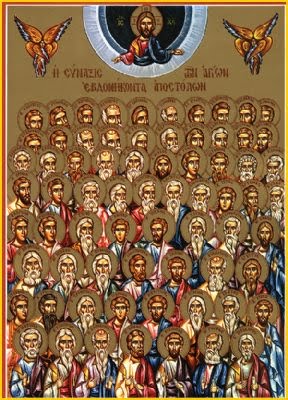
There is a huge misconception about what constitutes authority to teach what the truth is today. Many people in America seem to be under the impression that education is what gives one the authority to teach the scriptures in a church. Simply studying the Greek and Hebrew and a small amount of church history grants one the ability to instruct spiritual infants towards adulthood in the Christian faith.The problem with this is that once one becomes more educated than their authority, then they themselves now can take the thrones of authority for themselves, and authority is also then not authority at all, since one who is not educated, must determine for themselves what is proper and true teachings first before being instructed. Others believe that it is merely one that has true faith, and as long as one is a true believer, God then gives them words of wisdom to instruct others, making infants instructors, and those who are in adulthood hearers, which brings about anarchy. These two systems are the very reason as to why protestantism is such a mess. Once someone in the Calvinist church knows more than their pastor, what is stopping them from starting another church under the same banner of authority? It can’t be that they were not granted authority from their pastors, since Calvin and Luther were granted no such authority, and such a claim would require succession. As for having authority simply upon having faith, we must assume that when someone professes faith, which is merely predicated, they now have an ability to instruct without restraint.
However, can anyone have authority outside of being sent? Can one just pick up a microphone, or put the words “Church” on a building and determine that they are now able to preach and teach what their hearts tell them? This is precisely what has turned Christianity into a joke today. The secular world understands such ideas as foolish, and they see right through the confusion. What? You don’t believe in evolution because pastor Bob who has “true faith” told you it was wrong? You are sitting under the gospel, because your pastor went to college, and spent a semester learning Greek?
Jesus didn’t even come into this world under his own authority, but the Father who sent him. To put one’s faith into Jesus Christ, who was sent by the Father, and turn around and trust a man who was sent by nobody, is to put men above Christ. Jesus Christ chose apostles, and those apostles he chose he also commissioned to go out into the world and preach the gospel. So, Christ sent by the Father, the apostles sent by Jesus Christ, and the Apostles….hmmm?….what’s next? Something needs to be considered here. It seems as though a road block needs to be cleared in order to proceed with the connection of early church authority and onto modern times. Since it is so, that many believe that scripture is bound by the dying of the final apostle, it requires another topic to be considered.
What is authority? Or, more precisely, what is authority in regards to the Christian faith? Is the type of authority that bishops, priests and deacons have, the same as the type of authority politicians have, or bosses in the workplace have? It seems that they are different, or should be different, however, the way people first think of authority when addressed in Christianity, is without restraint, or as most protestants assume, wrongly I might add, like Roman Catholicism, who’s pope demands their obedience. But there is something else at play here. We submit to something no matter what. The scripture for example is considered infallible by protestants, Roman Catholics, and Eastern Orthodoxy, but in different ways. What is it that gets us to look at the scripture and think that it should be considered infallible? Or better yet, what is infallibility anyways? It seems as though we can all agree that if something is infallible, that it needs to be recognized as such, and submitted to.
How is it that St Paul wrote infallibly? Did God merely possess Paul’s body to write the gospels like Greek pagan oracles?
St Augustine denies such thoughts. However, it makes sense in regards to protestantism and how salvation works for this to be so. If nothing separates me, the new believer in the eyes of God, since Christ’s perfect life covers over me, then it seems as though the only way he could have written with such divine knowledge, and I am not able to, is if God intervened and directed his pen. But, that is completely pagan. Why then does God even need man to do such a thing? Why couldn’t God just, I don’t know, write his will with his finger on table
This is interesting. We actually do see God write something with his own hand. The famous story of Moses and his accent up Mt Sinai, where Moses would go stay for 40 days and 40 nights. During this time, God instructed Moses to inform the people to not even touch the edge of the mountain, or they would die. Not even animals could touch the mountain without dying. This proves that the it wasn’t just God’s pride that would get hurt if someone didn’t obey, but that Moses was in some way different, and was able to stand in the presence of God without being destroyed by God’s presence. The coincides perfectly with the Essence/Energy distinction found in St Gregory of Nyssa. Obviously, if one is to understand this distinction, we can experience God’s operations but not His essence. Even in heaven, since we will remain creatures, God’s essence will still be unknowable, but His energies will be knowable, but as fury to some, or, hell. St Theophanes said: “the divine light will be perceived as the punishing fire of hell”, However, it is taught in the early church, and still in Eastern Orthodoxy today, that those who are Holy experience the divine light.
So what is my point with all of this? What if Moses could receive revelation because he was holy? Why is it that Moses wasn’t destroyed by God’s glory, and even stood in God’s presence multiple times, and didn’t die? Yet, animals would have if they unknowingly wondered to close? What if infallibility is not pagan oracles, such as statues talking to us, or just merely men being used as conduits for the transferring of information? What if the apostles were writing from experiencing God, which is unknown to others who have not? What if the bible is a compilation of writings from Moses to St John who walked in high places, and brought down what they knew to be true, because they had experienced the presence of God? What if this is what is known as Glorification?
This extremely changes things in regards to how we would understand why it is we see the scripture as infallible. Now the question is, how does this change our understanding of authority?
The ecumenical councils are clear about the requirements of priests, deacons and bishops. It is not centered on academics, merely the profession of faith, but on noetic prayer. It is true, that in the early church, a theologian was someone who prayed, not one who was educated. This was one shift in Rome which led to the schism. Augustine had a passion for knowledge, yet had a concubine:
“It was a sweet thing to be loved, and more sweet still when I was able to enjoy the body of a women” (Confessions 3, 51)
This shift, slowly changed what it was to be a teacher of God. It went from those who know God through prayer and participation, to academic understanding. This led to sermons becoming worship. This is by far, the worst part of the great schism in my mind.
So who then determines who is fit to preach the gospel? Ourselves? Even more, how can we even understand the bible, unless someone who walks in the high places can explain such writings to us?
Now an angel of the Lord said to Philip, “Rise and go toward the south to the road that goes down from Jerusalem to Gaza.” This is a desert place. And he rose and went. And there was an Ethiopian, a eunuch, a court official of Candace, queen of the Ethiopians, who was in charge of all her treasure. He had come to Jerusalem to worship and was returning, seated in his chariot, and he was reading the prophet Isaiah. And the Spirit said to Philip, “Go over and join this chariot.” So Philip ran to him and heard him reading Isaiah the prophet and asked, “Do you understand what you are reading?” And he said, “How can I, unless someone guides me?” And he invited Philip to come up and sit with him.
We see here in Acts 8, that St Phillip is speaking with an Angel, which clearly illustrates that he is deified. As he goes over to the Ethiopian eunuch, who was a very educated man historian claim, since his position in regards to the Queen of the Ethiopians was that of a very educated man during this time, and he of all people, is honest enough to know that he needs to be instructed by someone who is holy.
Apostolic succession then, is not just authority, in a sense of academics, or having a certificate. It is the passing down of authority, after being examined by those who were deemed holy by other holy men before them, as men with the prayer of heart, and know God through participating in God’s divine energies. This is exactly why it does not matter what Calvin thinks the bible says, or Luther feels is true. If it is true, that we are all totally depraved, why trust Calvin, Luther, or more importantly, yourself ? Why let your emotions guide you? With the above illustration of infallibility and the passing down of authority, through proper confession, prayer and participation in God, we see a continuity that is not matched anywhere else in Christianity. We have an explanation as to how men wrote the bible, but it is infallible, how we can rely on the scriptures because of apostolic succession, and the Holy Spirit guiding these men through the laying on of hands, and how councils, in which bishops who are blameless among others in the church, can come to a collective consensus on what is true pertaining to God and His church. There is not problem between the continuity of why we see these things to be consistent, and to be honest, all other stances on scripture and tradition are faulty, and completely open for secular criticism, since they are off the wall, and not logical, and quite frankly, pagan in origin.
If protestants want to say that we rely on men rather than God, I wonder how it is they even believe Moses’s words, or the patristic fathers words on scripture, that it was in fact the bible passed down through the succession of bishops? I think that is called the law of contradiction.
 Wicket's take
